Search the Archives           Subscribe           About this News Service           Reader Comments


Archived updates for Friday, July 29, 2005

USPTO Announces New Reexamination Unit

In a press release issued on July 29, 2005, the United States Patent and Trademark Office (USPTO) announced that it has implemented a new process for handling reexamination proceedings. Under the new policy, "The USPTO's goal is that reexaminations that have been pending with an examiner more than two years now will be resolved by October 1, 2005. In addition, all future reexamination proceedings will be completed within a specific timeframe, which is expected to be less than two years."

More specifically, however, all reexaminations have been reassigned to a central reexamination unit, except for those where an initial decision has been made which will remain with the examiner originally assigned to the reexamination. The new, 20-examiner unit began operation earlier this week and is also receiving all new requests for reexamination. Prior to the new initiative, reexamination cases were assigned to examiners according to technology, and often went back to the same examiner that originally allowed the claims under reexamination. The USPTO hopes that using dedicated examiners who are assigned to the same unit will enhance the quality and reduce the time of reexaminations by allowing the USPTO to monitor reexamination operations more effectively.

In March 2005 there were over 420 reexaminations that had been pending more than two years and that number would have grown to over 600 by the end of September 2005. The announcement did not address whether reexaminations filed by a losing party (or their strawman) after a full trial on the merits would receive any special treatment.
    (3)comment(s)     permalink     translate         Send    

TGIF for the Anonymous Patent Examiner Blog

Here are just some of the excellent insights from the "Just a Patent Examiner Blog."

On July 11, 2005 regarding "Motivation to Combine:"

. . . for a good paper on the myriad court decisions related to motivation, see Harold R. Brown III’s “Finding Motivation, Teaching or Suggestion in the Prior Art” in the October 2004 Journal of the Patent and Trademark Office Society . . . .

If you want the average examiner’s eyes to glaze over (or me to disregard your arguments), put 4 pages of arguments citing 10 different pieces of case law regarding the motivation to combine. I simply don’t have the time to research all of the case law you've cited to figure out which applies and which does not. I don't mind seeing responses like that, because suddenly I find that what I thought was a 6 page response consists of only two pages that actually need to be responded to.

If an attorney wants me to seriously consider their arguments that my motivation is no good, they need to pick one piece of case law, and please, tell me why it applies to the particular circumstances of this application. Then I’ll be happy to consider the arguments.

Please, only one piece of case law at a time. [Read the comments here.]

On July 20, 2005 regarding "The One-Hand Rule:"

Physics has the right-hand rule.

Patent examination has the one-hand rule.

The rule, as I've heard it stated, says that if a claim is longer than the length of the examiner's hand, it's allowable. I've heard it more than once, from more than one examiner. The thing is, it's a complete fallacy. I know of not a single examiner, not even the ones from whom I've heard it, who actually subscribe to it. . . .

An attorney filed an RCE, and canceled all of the 30-some claims except for
a few independent claims, into which they incorporated all of the dependent
limitations. The remaining independent claims were roughly analogous, and were
each about two pages long. The thing was, though, that they had failed to
incorporate anything new; all they did was incorporate existing limitations.
Sure, the claims were long, and they included a whole lot of limitations, but
they were the same limitations that I'd already previously rejected. In that
case, the attorney made it easy on me. All I had to do to was to combine the
rejections that I'd already written.

on May 10, 2005 regarding "Patent Examination vs. Patent Prosecution:"

Why am I not in law school?

As I said, when I had been at the Office for two years and was eligible to apply, I really didn't feel the need. First of all, attending law school at night while working a full-time job (especially one as demanding as patent examining) would certainly be no picnic. And you're stuck doing it for FOUR YEARS.

OK, suppose I finish law school and now I have my law degree. I could waive into the patent bar, having already worked at the Office for at least 4 years, so I'd be free to leave (after working off the debt to the Office) and go work in private practice. Instead of sending out the rejections, I'd be writing the applications and sending in the amendments.

Well, to be perfectly blunt, I'd rather be doing what I'm doing now. Yes, I make less money. But I get to work semi-normal hours with a semblance of a life away from work. But the real deciding factor is that I like the idea of working to protect the public interest, preventing crappy patents from issuing, rather than to having to try to get some examiner to issue my crappy patent because that's what my client is paying me to do. That's the bottom line.

I could always go to law school, get the degree and stay at the Office. It would certainly allow me to do my job better, and would open up options for jobs here at the Office that require a law degree. Maybe one of these days I'll decide that I want to do it. But not yet. I like what I'm doing. So, for now, I'm content to remain Just a Patent Examiner.


With a truly noble calling, no less.

Thank Goodness It's Friday (and hopefully the end of the Examiner's bi-week),

--Bill Heinze
    (0)comment(s)     permalink     translate         Send    

Free Spyware/Adware and Junk Removal Tools

According to an October 2004 study by America Online and the National Cyber-Security Alliance, 80% of surveyed users' computers had some form of "spyware," with an average of 93 spyware components per computer. 89% of surveyed users with spyware reported that they did not know of its presence, and 95% reported that they had not given permission for it to be installed.

Your PC may well be similarly infested. But, don't panic. You can get free spyware/adware removal tools via ZDNet here and read PC Magazine's 2003 review of spyware removal tools here.

Once you get rid of the spyware, you can also get rid of all the other junk with CCleaner, and then obliterate what was left behind with Eraser.
    (0)comment(s)     permalink     translate         Send    

BusinessWeek on Brand Equity

The July 27, 2005 issue of BusinessWeek Online has a section on Brand Equity Innovation and Design. They offer this advice for Creating an Effective Brand: "First, make sure your business fundamentals, product platform, and value proposition are well in place. Without that, branding won't help."
    (0)comment(s)     permalink     translate         Send    


Archived updates for Thursday, July 28, 2005

Control and Customer Awareness Critical to Experimental Use Exception


In order for a patent claim to be held invalid under the on-sale bar of 35 USC §102(b), the claimed invention must be (1) the subject of a commercial sale and (2) ready for patenting. In Electromotive Division of General Motors Corp. v. Transportation Systems Division of General Electric Co., et al. (Fed. Cir. July 27, 2005), there was no question as to whether EMD's bearing inventions were "ready for patenting" at the time of the alleged commercial sales. Thus, the relevant inquiry concerned only the first prong of the Pfaff test, and, in particular, "whether the circumstances surrounding a pre-critical date sale objectively show that it was primarily made for experimentation."

The court began by discussing its non-exclusive list of thirteen objective factors relevant to determining whether pre-critical date activities involving the patented invention --either publlic use or sale– were primarily experimental, and therefore not commercial. See Allen Eng’g, 299 F.3d at 1353 (citing EZ Dock, 276 F.3d at 1357 (J. Linn, concurring)). It then went on to "hold not only that customer awareness is among the experimentation factors, but also that it is critical" and to "conclude that control and customer awareness ordinarily must be proven if experimentation is to be found."

In March 1993, EMD approached Union Pacific railroad for permission to substitute its new planetary bearings for prior art bearings in an order for two locomotives that Union Pacific placed earlier in 1992. Union Pacific allegedly agreed. Nevertheless, it did not sign a confidentiality agreement or any other type of a contract consenting to participate in the field program. Union Pacific also was not placed under any restrictions or supervision regarding the use of the locomotives containing new planetary bearings. Nor was Union Pacific given any design details for the new planetary bearings or required to monitor or document its usage of the subject locomotives during the field program. On September 29, 1994, EMD filed a patent application for its new planetary bearings.

The court compared these facts to those in Lough v. Brunswick Corp., 86 F.3d 1113 (Fed. Cir. 1996):
The facts here are closely analogous to those in Lough, where, as noted
above, this court rejected an inventor’s claim that a pre-critical date public
use of his liquid seal assembly invention was made for experimentation. In
Lough, the inventor distributed six prototypes of his liquid seal assembly
invention to his friends for use in their boats. After distribution, the Lough
inventor did not maintain any supervision over his friends’ use of the liquid
seal assemblies or follow-up with them for comments as to the operability of the
liquid seal assemblies. Similarly, EMD allowed Union Pacific unsupervised use of
the new planetary bearings. EMD neither monitored the conditions under which
Union Pacific used the new planetary bearings nor solicited any feedback from
Union Pacific regarding the bearings’ performance. What is more, EMD, like the
inventor in Lough, did not maintain any records of the alleged testing or
require Union Pacific to do so. As we stated in Lough, "Lough’s failure to
monitor the use of his prototypes by his acquaintances, in addition to the lack
of records or reports from those acquaintances concerning the operability of the
devices, compel the conclusion that, as a matter of law, he did not engage in
experimental use." 86 F.3d at 1122. We are equally compelled to conclude as a
matter of law that EMD did not engage in any experimentation on its new
planetary bearings.

Professor Wegner has already commented that "This case is a grand synthesis of the law of experimental use insofar as § 102(b) is concerned. Surely, it will be regarded as a leading case. Electromotive Division takes a hard ball approach that limits the circumstances under which an 'experimental' use will be found."
    (1)comment(s)     permalink     translate         Send    

U.S. Copyright Royalty Board Seeks Comments on Sound Recording Formats

The Interim Chief Copyright Royalty Judge has issued a supplemental request for comments regarding rules for the delivery and format of records of use of sound recordings for statutory licenses under sections 112 and 114 of the Copyright Act. The Board found that it would be very difficult to adopt final rules on the basis of the public comments received and hopes to induce interested parties to provide more specific information regarding the burdens of data submission in the webcasting industry.

For further information, go to the new Copyright Royalty Board website at http://www.loc.gov/crb.
    (0)comment(s)     permalink     translate         Send    

New Registered Community Design Search Capabilities Coming Soon

According to the latest issue of Alicante News, European Registered Community Design records will soon be fully searchable based on the bibliographic data (filing date, RCD number, products, Locarno classification), verbal elements contained in the design, and figurative elements using the Vienna Classification. "RCD-Online will be soon be available at http://oami.eu.int/en/db.htm (in English only – other linguistic versions will be available later)."

This news is significant because the Community Design Bulletin is currently searchable with only simple text queries. Since it can not be searched by date or classification, it has not been particularly useful for prior art and/or infringement clearance investigations. Hopefully, this will change when RCD-Online becomes available.

Click here for more information from Europe's "OHIM" on "Design protection of brand symbols - a useful alternative to trade mark protection?"

Click here for more information on "Regulations to Amend Implementing Regulation and Fees Regulation for Community Trade Marks – Amendments Enter into Force on 25 July 2005."

    (0)comment(s)     permalink     translate         Send    

Most Frequent PCT Users in 2004


The PCT World

According to the July 2005 PCT Newsletter, 235 applicants accounted for 37,217 (33.1%) of the 112,558 international applications published in 2004. Of these 235 applicants, 183 were from one of the following three countries: the United States of America (39.1% of the total), Japan (25.5%), and Germany (13.2%). There were also 97 applicants in each of whose names 100 or more international applications were published. Koninklijke Philips Electronics N.V. was, for the fourth consecutive year, the largest PCT user, with 2,697 international applications published,
followed by Matsushita Electric Industrial Co. Ltd. (1,415) and Siemens Aktiengesellschaft
(1,252).

Here are the 35 most frequent PCT users for 2004, listing applicant country of residence and
number of applications published:

1. Koninklijke Philips Electronics N.V. NL 2,697
2. Matsushita Electric
Industrial Co. Ltd. JP 1,415
3. Siemens Aktiengesellschaft DE 1,252
4. Fujitsu Ltd. JP 970
5. Robert Bosch GmbH DE 791
6. Sony Corp. JP 753
7. Nokia Oyj FI 733
8. Motorola, Inc. US 618
9. BASF Aktiengesellschaft DE 588
10. Bayer DE + others 548
11. 3M Innovative Properties Co. US 525
12. DaimlerChrysler AG DE 491
13. Infineon Technologies AG DE 461
14. Intel Corp. US 459
15. International Business Machines Corp. US 425
16. Qualcomm Inc. US 407
17. E.I. Du Pont de Nemours and Co. US 395
18. Thomson Licensing S.A. FR 392
19. Honeywell International Inc. US 380
20. Kimberly-Clark Worldwide, Inc. US 379
21. The Procter & Gamble Co. US 367
22. Telefonaktiebolaget LM Ericsson (publ) SE 364
23. Philips Intellectual Property & Standards GmbH DE 357
24. Mitsubishi Denki Kabushiki Kaisha JP 344
25. Sharp Kabushiki Kaisha JP 306
26. LG Electronics Inc. KR 305
27. Samsung Electronics Co. Ltd. KR 292
28. Scimed Life Systems, Inc. US 279
29. The Regents of the University of California US 278
30. Medtronic, Inc. US 264
31. AstraZeneca AB SE 254
32. Japan Science and Technology Agency JP 253
33. Tokyo Electron Ltd. JP 237
34. Canon Kabushiki Kaisha JP 222
35. NEC Corp. JP 221

    (0)comment(s)     permalink     translate         Send    

WIPO Lauches New PCT Web Portal

WIPO has launched a new web portal for all patent and PCT-related services and activities. Information on PCT filing and all PCT services are available through the new portal. In addition, a PCT Online File Inspection System is available for testing and comments, along with sections on patent data, statistics and current issues.
    (0)comment(s)     permalink     translate         Send    

An Incremental Cost-Benefit Analysis of Worldwide Patent Coverage

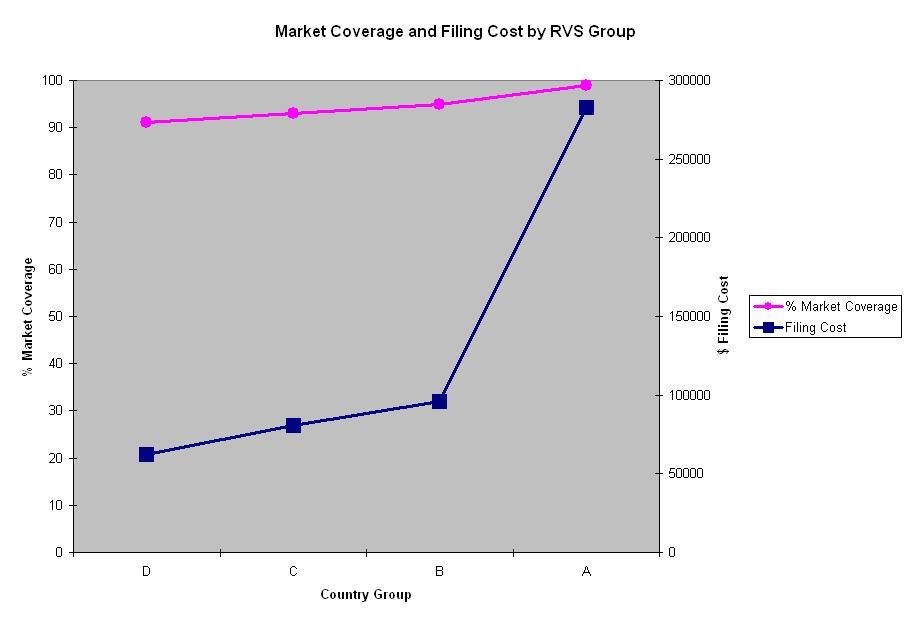
In "Patent Filing Strategies for Pharmaceutical Products: A Simple Cost-Benefit Analysis Based on Filing Costs and Pharmaceutical Sales," AIPLA QJ (Spring 2005), Robert Silverman, General Counsel at Millenium Pharmaceuticals, looks at what countries should be protected in order to get the most bang for the pharmaceutical patent buck. His analysis starts with a "Return Value Score," or RVS, that divides each country's pharmacetical sales by its patent filing cost. He then divides the 44 countries that he considered into 4 groups depending upon their RVS:
  • Group A - all counries, average RVS=1.6 (99% market coverage, $283,000 filing cost)
  • Group B - all countries with an RVS=10 or greater, RVS=138 (95%, $96,000)
  • Group C - PCT member countries with an RVS=10 or greater, RVS=161 (93%, $81,000)
  • Group D - All countries with an RVS of 20 or greater, RVS=206 (91%, $62,000)

These numbers, along with his estimated PCT national stage filing cost data, result in the following chart showing Percent Market Coverage and PCT National Stage Cost for each Group:

Mr. Silverman draws two conclusions from this chart. First, selecting option B over option D, increases filing costs about 35% in order to gain exclusivity in only about an extra 4% of the world market. Second, the cost of exclusity increases dramatically for anything over about 95% of the world market.

He goes on to explain why reducing translation cost (such as by reducing the number of pages in the speciification) is not likely to matter when the RVS for a particular country is well below a minimum RVS, such as 138 for Group B. However, when the analysis is focussed on just European Patent Convention members, the high translation costs for Sweden, Denmark, Hungary, and Finland, mean that "omission of these four countries might make sense in a European-lite strategy."

Furthermore, since most of the revenue attributable to a European pharmaceutical patent is produced during the period of the so-called "Supplementary Protection Certificate," patents in Denmark, Finland, Slovakia, Latvia, and Estonia can have a negative net present value. However, the NPV calculation can be highly sensitive to certain variables, especially in countries where the NPV is only slightly negative.

Nonetheless, there are still big differences in the patent strategies of pharmaceutical companies. Some companies routinely file patent applications in fifty to seventy countries while others file in over ninety countries.

    (0)comment(s)     permalink     translate         Send    


Archived updates for Wednesday, July 27, 2005

Europe Publishes R&D Intensity Figures

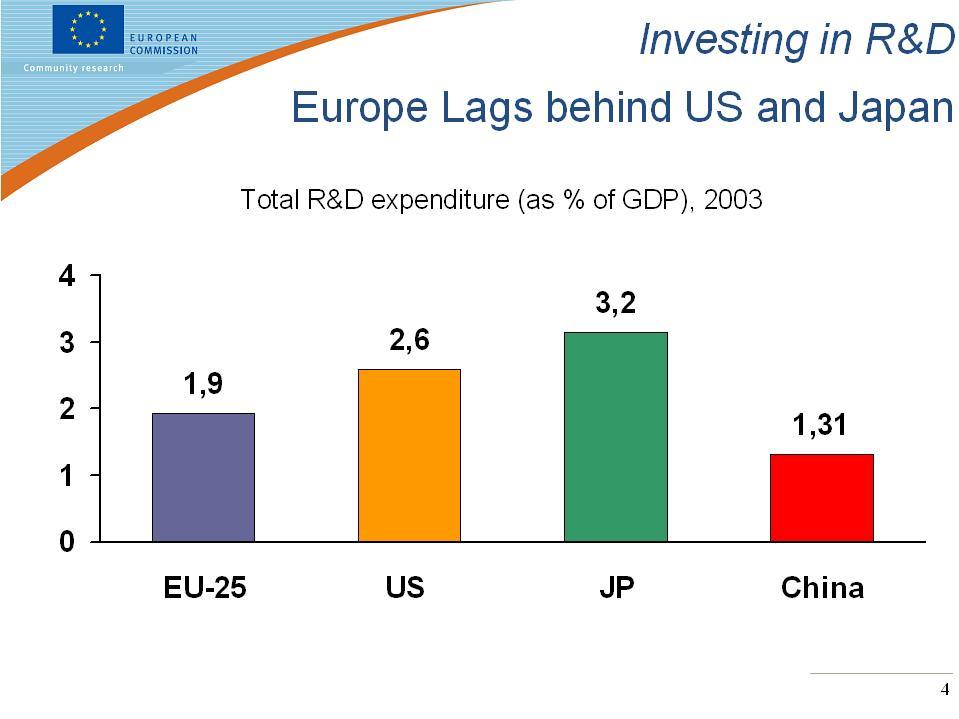
The European Commission published its "Key Figures 2005 on science, technology and innovation" on July 19, 2005, revealing stagnation in research and development (R&D) investment in the EU and U.S.

In a presentation entitled "Wake-Up Call for Knowledge Europe," EU Science and Research Commissioner Janez Potocnik reportedly described the numbers as 'particularly worrying'. The figures show that EU R&D intensity, growth of R&D investment as a % of GDP, is close to stagnation. China's R&D intensity, on the other hand, has been growing at around 10 per cent annually since 1997. According to Potocnik, "If current trends for both China and the EU-25 hold on in the coming years, China will have caught up with the EU by 2010 in terms of the share of GDP allocated to R&D."

Europe devotes a much lower share of its wealth to R&D than the US and Japan (1.93% of GDP in the EU in 2003, as compared to 2.59% in the US and 3.15% in Japan). While China has lower R&D intensity (1.31% of GDP in 2003) it grew at about 10% per year between 1997 and 2002. If these trends in the EU and China continue, China will be spending the same amount of GDP on research as the EU in 2010 – about 2.2%.
    (0)comment(s)     permalink     translate         Send    

Prosecution History Invokes Rule Against Recapture


In North American Container, Inc. v. Plastipak Packaging, Inc., et al. (Fed. Cir., July 14, 2005), the court invaildated reissue claims 29-42 of U.S. Reissue Patent 36,639 (left) for violating the rule against recapture.

During prosecution of the parent application, the originally-filed claims were rejected as obvious over Dechene (middle) in view of Jakobsen (right). In response to the original rejection, the applicant amended his claims by specifying that the shape of the inner walls in his invention was "generally convex." The applicant also distinguished the claimed invention from the prior art by making the following argument:


The independent Claims 15, 24 and 33 have been amended to refer to the convex
nature of the inner wall portions of the central re-entrant portion (i.e. those
wall portions disposed inwardly of the lowermost points of the base upon which
the container rests) . . . . The shape of the base as now defined in the claims
differs from those of both the Dechenne patent [middle], wherein the corresponding wall portions 3 are slightly concave . . . and the Jakobsen patent [right], wherein the
entire re-entrant portion is clearly concave in its entirety. This is also
generally true of all of the prior art known to the applicant and/or referred to
by the examiner.
During reissue, the applicant added new claims which deleted the claim language "inner wall portions are generally convex" because, according to the patentee, "the invention is not limited to such a structure." Protests were filed under 37 C.F.R. § 1.291(a) by manufacturers and
distributors of bottles against the newly added claims, alleging violation of the recapture rule on the ground that "subject matter which the reissue applicant has intentionally removed from the reissue claims . . . is the same subject matter that was introduced during prosecution of the original patent in order to distinguish over the prior art." However, the examiner rejected the protests, stating that the reissue claims "are considered to be of intermediate scope and the deleted language such as that directed to the convexity of the inner wall . . . are not considered to be critical limitations." ’ The examiner then allowed the newly added claims and U.S. Patent 5,072,841 patent was reissued as Reissue Patent 36,639.

Under the recapture rule, a patentee is precluded "from regaining the subject matter that he surrendered in an effort to obtain allowance of the original claims." The Federal Circuit applies the recapture rule as a three-step process:
  1. first, determine whether, and in what respect, the reissue claims are broader in scope than the original patent claims;
  2. next, determine whether the broader aspects of the reissue claims relate to subject matter surrendered in the original prosecution; and
  3. finally, determine whether the reissue claims were materially narrowed in other respects, so that the claims may not have been enlarged, and hence avoid the recapture rule.
In applying that process in this case, the court did not give any deference to the Examiner's analysis of criticality:

The examiner’s basis for denying the protests filed against the reissue claims,
i.e., that the claims "are considered to be of intermediate scope and the
deleted language . . . directed to the convexity of the inner wall . . . are not
considered to be critical limitations," demonstrates the examiner’s inattention
to the rule against recapture. For the reasons set forth above, the deleted
language was critical in that it allowed the applicant to overcome the Dechenne
reference. Moreover, that the reissue claims, looked at as a whole, may be of
"intermediate scope" is irrelevant. As the district court recognized, the
recapture rule is applied on a limitation-by-limitation basis, and the
applicant’s deletion of the "generally convex" limitation clearly broadened the
"inner wall" limitation. Thus, reissue claims 29-42 are invalid for violating
the rule against recapture.
    (0)comment(s)     permalink     translate         Send    

Three-Blade Propeller Design Patent Not Infringed by Four-Blade Configuration


In Hartco Engineering, Inc. v. Wang's International, Inc., et al. (Fed. Cir., July 25, 2005, non-precedential) the court concluded that no reasonable jury could have concluded that the overall visual appearance of the claimed design (above, left) is substantially similar to the accused design (right):
"Comparing the two designs, we disagree with the district court that the
jury verdict of design patent infringement was supported by substantial
evidence. The designs do not have to be identical to an accused device to be
protected, see OddzOn, 122 F.3d at 1405, but Hartco’s patented design is limited
to the design it claimed with the three-blades and four circular features.
Appellants’ four-blade product has a substantially different overall ornamental
appearance from the claimed three-blade product. See Elmer, 67 F.3d at 1577-78.
As no reasonable jury could have concluded that the overall visual appearance of
the claimed design is substantially similar to the accused design, we do not
need to employ the point of novelty test. See KeyStone Retaining Wall Sys., 997
F.2d at 1451. We thus reverse the district court’s denial of judgment of noninfringement as a matter of law, together with the award of damages for design patent infringement."

Although this decision is not citable as precedent under Fed. Cir. R. 47.6, the also court noted that the inclusion of blades, a nose, and a tongue "are part of the general propeller concept and not protected ornamental aspects independent of their unique configuration." Instead, only the number and shape of the blades, as well as the four circular features, were ornamental aspects, subject to patent protection.

    (0)comment(s)     permalink     translate         Send    


Archived updates for Tuesday, July 26, 2005

EC Reports on Patenting of Biotechnology in Europe

As a follow-up to its first report in 2002, the European Commission has now adopted a second report (COM(2005)312) to the Council and European Parliament covering developments and implications of patent law in the field of biotechnology and genetic engineering. The latest report focuses on issues in the area of patents relating to gene sequences and the patentability of inventions relating to stem cells. It also reports on the implementation of Directive 98/44/EC on the legal protection of biotechnological inventions.

The report looks at whether patents on gene sequences (DNA sequences) should be allowed according to the classical model of patent claim, whereby a first inventor can claim an invention which covers possible future uses of that sequence, or whether the patent should be restricted so that only the specific use disclosed in the patent application can be claimed (“purpose-bound
protection”). It concludes that "the Commission does not at present intend to take a position on the validity of transposition according to the choice between classical and limited scope of
protection for gene sequences. The Commission will, nonetheless, continue to monitor
whether there are any economic consequences of possible divergences between Member
States’ legislation."

With regard to stem cells, the report notes a distinction between totipotent stem cells, which are capable of developing into a human being, and pluripotent stem cells, which are not:

The provisions of the Directive are clear in relation to totipotent stem cells, since each cell could develop into a human being on its own and under Article 5(1) the human body at the various stages of its formation and development cannot constitute a patentable invention. This principle has been reiterated in the practice notice issued by the UK patent office in April 2003.

For pluripotent embryonic stem cells the situation is more complex. The Group of Experts considered that the question of patenting was closely linked to the definition of what constitutes an embryo, and the scope of research allowed, which is determined by national legislation. As regards research funding under the European framework programmes, such funding may be available for projects involving human embryonic stem cell research on a case by case basis.

In the light of the clear divergences which currently exist between Member States as regards the acceptability of research relating to embryonic stem cells, the continuing and rapid developments in this field, and the fact that the Directive itself provides for Member States to refuse patents on grounds of public order or morality under Article 6(1), the Commission considers that it is premature to give further definition or provide for further harmonisation in this area. At the same time the Commission will monitor developments taking into account both the ethical aspects and the potential impact on competitiveness. It has launched a study looking at the ethical and legal aspects of stem cell patenting.

Click here for the European Commission's webpage on biotechnology inventions.
    (0)comment(s)     permalink     translate         Send    

Post-Dated Items in U.S. Trademark Document Retrieval System

Anne Downey, of Downey & Downey, reports on the INTA Listserv that "Regarding post-dated Notices of Allowance, I was told by a PTO representative that the PTO is aware of the issue. The NOAs get printed in advance andsometimes are mailed out prior to the NOA date. They are not uploaded into the Trademark Document Retrieval ("TDR") database until the NOA date occurs."

The TDR system displays the electronic file wrapper of U.S. Trademark applications and applications for Extensions of Protection, as well as U.S. Trademark Registrations. It also displays information contained in the USPTO records regarding International Registrations and applications for International Registration filed under the Madrid system through the U.S. Currently, you can access almost all pending applications and all Madrid Protocol filings, and many registrations, via TDR.

The USPTO is in the process of converting all remaining registrations into a digital format, so as to permit future TDR access. This conversion process is expected to take several years. Please consult the frequently asked questions for more information regarding what is available in TDR.
    (0)comment(s)     permalink     translate         Send    


Archived updates for Monday, July 25, 2005

MARQUES Unveils GI Legislation Database


According to the July 24, 2005 issue of Managing Intellectual Property, the MARQUES association of European trade mark owners, has launched a database of legislation covering geographical indications (GIs). The database reportedly includes information on international agreements, EU regulations, and national legislation on GIs in 22 European jurisdictions, and is available to MARQUES members online here.

Get a free trial of "Managing Intellectual Property" here.
    (0)comment(s)     permalink     translate         Send    

.HK Registrar Offering Temporary Chinese-Language Domain Name Registrations

According to the July 24, 2005 issue of Managing Intellectual Property, the registrar for the .hk domain, is running a Chinese domain name trial until December 29 this year, and plans to launch the service properly next year.

"CDN" domain name registartions from Hong Kong Domain Name Registration must include at least one Chinese character, either traditional or simplified, and can also contain Roman characters. Anyone can apply for a Chinese character .hk domain during the trial period, and there is no charge. But all registrations will be deleted on December 29.

Unfortunately, so-called "internationalized domain names" still lack formal rules from ICANN.
    (1)comment(s)     permalink     translate         Send    

Israel Named U.S. Intellectual Property Czar


On July 22, 2005, the U.S. Department of Commerce announced that Chris Israel has been tapped as the new Coordinator of International Intellectual Property Enforcement. Israel will head the international work of the National Intellectual Property Law Enforcement Coordination Council (NIPLECC) and coordinate and supervise international intellectual property protection plans among other agencies.

Since 2004, Israel has served as Deputy Chief of Staff for the Secretary of Commerce. Prior to becoming Deputy Chief of Staff, he was Deputy Assistant Secretary for Technology Policy at the Commerce Department. Before joining the Commerce Department, Israel was a public policy executive at Time Warner. He has also worked as legislative aide to Representatives Jan Meyers and Todd Tiahrt. Israel received his B.A. from the University of Kansas and his M.B.A. from the George Washington University.

The National Intellectual Property Law Enforcement Coordination Council's mission is to coordinate domestic and international intellectual property law enforcement among federal and foreign entities. The Council consists of the following seven officials: the Under Secretary of Commerce for Intellectual Property and Director of the United States Patent and Trademark Office; the Assistant Attorney General, Criminal Division; the Under Secretary of State for Economic, Business, and Agricultural Affairs; a Deputy United States Trade Representative; the Commissioner of Customs; the Under Secretary of Commerce for International Trade; and in a consulting capacity, the Register of Copyrights.
    (0)comment(s)     permalink     translate         Send    

Webster U. Offers MA in Patent Agency

Webster University of St. Louis is offering a Master of Arts in Patent Agency. According to their program description, the global legal community is experiencing an increasing demand for intellectual property law services, thereby resulting in an increasing demand for patent agents knowledgeable in the field of intellectual property law. The patent agency program prepares students who have a science or engineering background to practice as patent agents before the United States Patent and Trademark Office in patent cases:
The program provides the theoretical and practical knowledge needed to
enter the field of patent agency well-prepared to prepare and prosecute patent
cases. [Since] the written portion of the Patent Agent Bar Examination has
recently been eliminated. . . many patent agents who pass the
examination could be entering the work force with virtually no preparation in
patent application drafting. A course of study that teaches students the art of
patent drafting, such as this one, will likely result in the student being more
competent, marketable, and hopefully, more highly compensated.

The 36 credit hours required for the M.A. degree include the following courses:

  • LEGL 5000 Introduction to Legal Studies (Requisite Course)
  • LEGL 5260 Methods of Legal Research and Writing I
  • LEGL 5900 Foundations of Intellectual Property Law
  • LEGL 5910 Patent Law
  • LEGL 5920 Patent Drafting
  • LEGL 5930 Patent Prosecution
  • LEGL 5940 Patent Law Regulations, Procedures, and Ethics
  • LEGL 5950 Patent Litigation in the Federal Circuit
  • LEGL 6030 Integrated Practices in Patent Agency
    (0)comment(s)     permalink     translate         Send    


Archived updates for Friday, July 22, 2005

Average Patent Application Backlog by USPTO Technology Center

Dennis Crouch at the Patently-O Blog has taken the USPTO's “average filing date of applications receiving a first office action” and calculated an average backlog, in months, for each technology center. The backlog ranges from a low of 10 months for plant patent applications in TC 1660 to a high of 40 months for multiplex communication patent applications in TC 2660. Dennis adds that
Although this is unconfirmed, I believe that these numbers are somewhat
skewed because they include continuing applications that generally have a
shorter delay before receiving a first office action. As such, the expected delay for a newly filed non-continuation may be greater than that listed. Nonetheless, the table is useful for providing a new applicant a better estimate of the expected timetable.
Dennis also notes that Stephen Nipper's Invent Blog has provided a concise explanation of how to use the pendency table here and John Doll, the PTO’s Acting Commissioner for Patents recently gave a presentation on this and other topics at the NAPP meeting here.

Nice blogging, guys.
    (0)comment(s)     permalink     translate         Send    

U.S. and Brazil Square-Off on WIPO Development Agenda

According to a July 21, 2005 report from Intellectual Property Watch, "the United States put a political stake in the ground" at the start of day two of a meeting on reform of the World Intellectual Property Organisation by calling for the meeting to recommend moving development issues to an existing technical committee:

The U.S. proposal is in marked contrast to a proposal put forward on day one by Brazil on behalf of 14 countries referred to as the "Friends of Development." The original Friends of Development proposal was introduced at the 2004 WIPO General Assembly last Fall, which mandated that an Intersessional Intergovernmental Meeting (IIM) discuss the proposal and make a recommendation by the end of July for the 2005 General Assembly. The current 20-22 July IIM is the third and final three-day meeting since April.

The U.S. suggestion to move development issues to the Permanent Committee on Cooperation for Development Related to Intellectual Property (PCIPD) reflects a proposal put forward at the April IIM by the United Kingdom. Canada proposed at the last meeting of the PCIPD – which followed immediately after the April IIM – that the body be reorganised to address broader concepts.

Brazil, India and others have argued repeatedly that the fundamental changes they are calling for must reach beyond the PCIPD into a range of committees and procedures at WIPO. “I think the U.S. totally rejects anything that changes this organization’s modus operandi that helps developing countries,” a Brazilian delegate charged. “I hope I am not correct.”

The U.S. delegate assured Brazil that his government has expressed a “willingness to discuss” development issues and fully supports U.N. efforts. But he said the United States disagrees with the premises upon which Friends of Development proposal is based – that WIPO has not dealt with development issues, and that intellectual property rights have not been positive for innovation.

Another area of contention between the United States and Brazil was a proposal put forward by Brazil for WIPO to negotiate an “access to knowledge” treaty. Brazil said there is a problem of the appropriation of publicly funded “basic science” and research by private companies which has the effect of removing the knowledge from the public domain.

The access to knowledge treaty, sometimes referred to as the A2K treaty, would ensure this information remains public, feeding science and research, Brazil said. WIPO must address this problem, he said, adding, “We believe an access to knowledge treaty is the real power tool that WIPO should pursue.” Brazil’s delegate cited “worrisome” legislation in the United States that encourages the transfer of more research from universities to private sector, which he said would lead to more monopolies and less innovation.

The United States said it cannot support the proposal, and that it “strongly disagrees” with the principles underlying it and views it as “unnecessary.” Intellectual property has been a strong driver of innovation rather than an impediment, the U.S. said.

The European Union could be the wild-card in the debate, as the United Kingdom’s statement did not reject the access to knowledge treaty proposal, and said WIPO has a role in the debate. On Thursday, the European Union proposed that talks on a stronger development-oriented agenda for the World Intellectual Property Organisation be continued through 2006.

Intellectual Property Watch is a non-profit independent news service reporting on the interests and behind-the-scenes dynamics that influence the design and implementation of international intellectual property policies. They are funded through a combination of grants from private philanthropic foundations, individual donations and subscriptions and received start-up funding through the Center for International Environmental Law, supported by the Open Society Institute and the Rockefeller Foundation.

Click here to get free e-mail notifications for new reports from Intellectual Property Watch.
    (0)comment(s)     permalink     translate         Send    

WIPO Offers On-Line ADR Document Facility

The Arbitration and Mediation Center of the World Intellectual Property Organization has launched a new WIPO Electronic Case Facility ("ECAF") for on-line documentation access.

Through its secure online docket function, WIPO ECAF facilitates submission of case filings and enhances access by concerned parties. As an alternative to dispatching heavy packages to multiple locations, parties may submit communications – documents of hundreds of pages, recorded witness statements, etc. – electronically into a secure online docket. This prompts the dispatch of an email alert to all other actors involved in the case. Parties may view this docket at any time from any location through the Internet. The search function of the online docket facilitates access to case documents and allows easy organization of the documents by chronology or by party. WIPO ECAF also provides, at a glance, core case information – case summary, overview of timelines, including in particular upcoming deadlines, contact information for all parties, and the financial status of the case.

Based in Geneva, Switzerland, the WIPO Arbitration and Mediation Center was established in 1994 to offer Alternative Dispute Resolution (ADR) options, in particular arbitration and mediation, for the resolution of international commercial disputes between private parties. Developed by leading experts in cross-border dispute settlement, the procedures offered by the Center are widely recognized as particularly appropriate for technology, entertainment and other disputes involving intellectual property.

Click here for more about the WIPO ADR procedures.
    (0)comment(s)     permalink     translate         Send    

TGIF for Gerry Thomas, Creator of the TV Dinner


Gerry Thomas, creator of the "TV Dinner" more than a half-century ago, died at the age of 83 this week.

Neccesity was truly the mother of his invention. "After Thanksgiving, Swanson had ten refrigerated railroad cars -- each containing 520,000 pounds of unsold turkeys -- going back and forth across the country in refrigerated railroad box cars, because there was not enough storage in warehouses. We were challenged to come up with a way to get rid of the turkeys," Thomas reportedly said.

Making use of aluminum serving dishes, used also at that time to serve dinners on aircraft, he packaged the leftover turkey with cornbread dressing, frozen peas and sweet potatoes, each in its own compartment. The entire dinner could be removed from the outer packaging as a unit, the aluminum tray could then be heated directly in the oven without any extra baking dishes, and you could eat the meal directly out of the same tray. According to USA Today, he came up with a three-compartment tray because "I spent five years in the service, so I knew what a mess kit was. You could never tell what you were eating, because it was all mixed together."

The first production order for 5,000 dinners required about two dozen women armed with ice cream scoops filling the new trays at night. But the key to its sucess was on coming up with the name and packaging to match the market. Few consumers owned freezers back then, so the dinners were typically bought and prepared the very same day.

"We had the TV screen and the knobs pictured on the package. That was the real start of marketing," Thomas said. And perhaps the start of something else. The dinners initially drew hate mail from men who wanted their wives to cook from scratch like their mothers did.

Get the official history of the TV dinner from Swanson and learn to cook with "The Single Man's Guide to TV Dinners" from Ray Cole.

Thank Goodness It's Friday,

--Bill Heinze (e-mail, v-card)
    (0)comment(s)     permalink     translate         Send    


Archived updates for Thursday, July 21, 2005

Overlooked Counterclaim Bounces Appeal and Costs Appellant

In Enzo Biochem, Inc. v. Gen-Probe, Inc., et al. (Fed. Cir., July 13, 2005), the trial judge concluded its hearing by asking the parties "if there is anything that I have missed in my rulings that I should rule upon." Both counsel responded that the court had covered all the issues raised, and Enzo’s counsel indicated that it would appeal the decision. The judge then stated that he would "enter a summary order . . . that will enable you to proceed with dispatch in the Federal Court of Appeals on your rights if I have erred" and the clerk of the district court entered judgment under Federal Rule of Civil Procedure 58 holding that all claims of the ’659 patent were invalid and that "the case was closed."

Gen-Probe moved to dismiss the appeal, arguing that its remaining unadjudicated counterclaim of unenforceability for inequitable conduct rendered the district court’s judgment nonfinal. The court agreed with Gen-Probe that its pending unenforceability counterclaim renders the district court’s judgment nonfinal for purposes of appeal:

Although it is true that the district court here did make a clear statement that the case was at an end, it was mistaken, because an unadjudicated counterclaim remained. Gen-Probe’s brief to this court, supported by the record, and unrefuted by Enzo, makes that clear. While it is, to say the least, regrettable that a party with a remaining counterclaim that it wishes to pursue, as well as its opponent, leaves a trial judge with the impression that no claims remain in the case, we have no choice
but to take cognizance of the nonfinality created by the unquestioned existence
of that counterclaim.
Notheless, after awarding costs, the court granted Enzo leave to seek remedial action in the district court and thereafter reinstate the appeal if and when the judgment becomes final.

Haven't these folks heard of the Take Your Adversary to Lunch program?
    (0)comment(s)     permalink